

Gold Peach 1996-2002: Series research on
Developing a learning web community
Wu, Tung-Xiung
Dept. of Information Management, Shih Hsin University
#1, Lane 17, Sec. 1, Mu-Cha Rd., Taipei 116, Taiwan, ROC
TEL/FAX: 886-2-22367114; email: txwu@cc.shu.edu.tw
Abstract: This series research attempted to develop an interactive platform concerned with web community learning for children and to design a quasi-experiment to understand the users learning behaviour. The series was conducted from 1996 to 2002. Five generations of web-human interaction and user interfaces have been developed and tested.
We found the web community model was a better design for web-based learning. The internet culture was an essential factor to consider in terms of the idea of software internationalization. Though we did not find a clear difference of learning achievement between users and non-users, we suggested that the concept of cultivation, which has a long tradition, deserved a new look.
Key words: web-based learning, interactive learning environments, web community, culture and cultivation
Introduction
This series research was divided into two stages that attempted to access the specific objectives as follows:
First, to develop an interactive learning platform Gold Peach for children based on the fundamental ideas of web community. This stage was conducted since 1996. There were five generations of web-human interaction and user interface which were developed and tested.
Second, to design a quasi-experiment including 3 primary schools to test the usability and to observe the learning behaviours in using Gold Peach. Two pre-tests and an interval test were undertaken. This stage was begun in 2001. The experiment is still on- going.
During the research, we also initiated discussions on culture and cultivation features for developing a web-learning environment.
Web community
Web community was a progressive and extended concept arising from the network-based learning community that was introduced by Lave et al. (1991)s' situated learning and modified by Qiou (1996). In recent years, researchers both from the fields of education and information systems have contributed specific ideas on how to build a web-based learning community from these various points of view. Reviewing relevant literature, the author brought together a new web community model as shown in Figure 1.
Most of existing learning websites are in centralized model that the web managers are also in charge of providing learning materials. On the contrary, the web community model is a distributed design. The web manager is only responsible for the maintenance of web mechanism while there are external moderators in preparing and guiding learning materials according to different subjects. The learning behavior in this model is an interactive community more than a top-down website.
Gold Peach this experimental learning environment, is developed by the idea of this model.
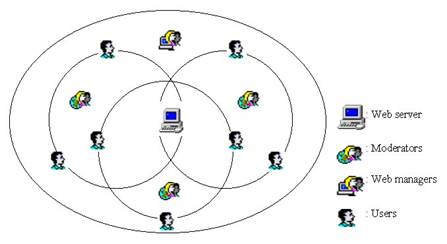 |
Figure 1. Web community Model
Quasi-experiment
A longitudinal quasi-experiment was designed and conducted from the spring semester of 2001 (also see Wu, 2002).
ᖼspan > Two small primary schools UJ and JM that were within the same location and of similar size were designed to be the quasi-experimental groups. One control group XK primary school was chosen with the same profile as the quasi-experimental groups.
ᖼspan > Students of third to sixth grade were designated users. One class of each grade was randomly selected from UJ and JM, while two classes of each grade were chosen from XK.
ᖼspan > All groups used Gold Peach took the same learning materials and same tests before and after training. The two quasi-experimental groups used Gold Peach as an enhanced supplementary learning web community, while the control group followed traditional classroom learning.
ᖼspan > Natural science materials were defined as the core task of the learning goal. All groups' learning achievement tests were measured 3 times every year, during the experimental program.
ᖼspan > A training course was prepared for the teachers of the experimental groups. This training presented the necessary knowledge and skills to run the web community for teachers. The teachers capability on using computers and their motivation on participating in the web community were also measured as further references.
Students learning achievement was examined using ANOVA techniques.
This series study is still going on.
Findings
Year 2001
In year 2001, the author found no differences between the students of the 3rd, 5th, and 6th grades. There was a P=.004 significant difference found for the 4th grade (shown in Table 2). The mean scores indicated the traditional learning students were even better than the web community learning students (shown in Table 1).
The author wanted to identify whether the difference derived arose from one extraordinary school in the experimental group. Comparing the F test with ANOVA, there was no difference between the two schools.
N
Mean
SD
SE
Experimental
61
77.8525
14.3115
1.8324
Control
54
84.4383
8.4100
1.1445
Total
115
80.9449
12.3118
1.1481
Table 1. Mean scores arising in experimental and control situations, 2001
SS
df
MS
F
P
Between
1242.352
1
1242.352
8.753
.004
Within
16037.855
113
141.928
Total
17280.207
114
Table 2. Significant difference demonstrated for 4th grade students, 2001
Year 2002
In year 2002, the author found no differences between the students of the 3rd, 4th, and 5th grades. There was a P=.003 significant difference found for the 6th grade (shown in Table 4). The mean scores suggested the web community learning students learning achievement were better than the traditional learning students (shown in Table 3).
N
Mean
SD
SE
Experimental
62
80.3290
9.4946
1.2058
Control
64
73.8719
13.7918
1.7240
Total
126
77.0492
12.2623
1.0924
Table 3. Mean scores arising in experimental and control situations, 2002
SS
df
MS
F
P
Between
1313.058
1
1313.058
9.313
.003
Within
17482.437
124
140.987
Total
18795.495
125
Table 4. Significant difference demonstrated for 6th grade students, 2002
A P=.042 significant difference was also found for the 3rd grade between the two schools (shown in Table 6). The mean scores indicated the students of JMs' learning achievement were better than UJᦼ/span>s (shown in Table 5). There is no difference for the other grades between the two schools.
N
Mean
SD
SE
UJ
31
64.3763
19.2692
3.4608
JM
29
73.1264
12.3051
2.2850
Total
60
68.6056
16.7362
2.1606
Table 5. Mean scores arising for 3rd grade students in two schools, 2002
SS
df
MS
F
P
Between
1147.186
1
1147.186
4.327
.042
Within
15378.701
58
265.150
Total
16525.887
59
Table 6. Significant difference demonstrated for 3rd grade students in two schools, 2002
In 2001, we found no particular factor related to the two classes teachers. The factors considered included teachers age, seniority, computer capability, participating motivation, etc.
However, in 2002, all participant teachers of JM have been changed since the change of the schools' President and their administrative policy, while the teachers of UJ remained the same. The new teachers were much younger and less senior than the former participants.
To sum up the overall information, we wanted to be careful and could not suggest any strong evidence to support the view whether web community learning or traditional learning is better. After checking detailed variables, we suggested that the difference came about as a result of a small number of students and their individual learning behaviour. We could not show that the learning environments in this experiment had made a clear difference. We considered that the experiment was too short to detect any cultivation effect.
Discussions and Conclusions
Web community: A progressive idea for learning environment
The web community could be considered as a progressive idea for a learning environment. It appeared to improve traditional teaching and display, and realised total participation and interaction.
Culture: On deficiency, excess and integration
Three generations of the user interface were developed during the last few years. It revealed that there was an introspective consideration in terms of the cultural features of web design. We did not find a balance between cultural skill and modern technique until the 3rd generation. It was found to be a long way to trace this back.
Cultivating use: A developmental attempt
The effort to discover the cultivation of use effect was still happening with the developmental period. Since cultivation is more likely to occur after a time series rather than a sudden change, the authors also suggest a large scale and longitudinal experiment on this issue in future studies.
REFERENCES
Lave, J. & E. Wenger (1991); Situated Learning: Legitimate Peripheral Participation; London: Cambridge Univ. Press
Qiou, Guei-Fa; (1996); Situated Learning Concept and Computer Assisted Learning; Taipei: National Normal Univ. Press.
Wu, Tung-Xiung; (2002) Series Research on Developing a Learning Web Community; in Passey, Don & Mike Kendall (eds.) TeIE-LEARNING: The Challenge for the Third Millennium, Montréal, Québec, Canada: IFIP 17th World Computer Congress &emdash
