

Gold Peach Web Community 2000: A Research on
Developing Web-Based Interactive Learning Environment
Wu, Tung-Xiung; Yui-Liang Chen
Dept. of Information Management, Shih Hsin University
#1, lane 17, Mu-Cha Rd. Sect. 1
Taipei, 116, Taiwan, ROC
TEL: 886-2-22368225 Ext. 376
FAX:886-2-22367114
Email: txwu@cc.shu.edu.tw
Abstract
This series research was based on the progressive concepts of web community, cultural and cultivation features to develop an interactive learning environment for children. The series was conducted from 1996 to 2000. There were four generations of web-human interaction and user interface has been developed and tested.
There were four functions in this community: total Web-Based CAI, interactive learning navigation, collaborative learning classroom, and community management.
Keywords: Web-Based Learning, Interactive Learning Environments, Web Community, Culture, Cultivation
 Specific
Objectives
Specific
Objectives
This series research attempted to access the specific objectives as follows:
Developing an interactive learning platform span class="en">Gold Peachᦼspan class="en"> for children based on the fundamental ideas of span class="en">web communityᦼspan class="en">.
Initiating the span class="en">culturalᦼspan class="en"> and span class="en">cultivationᦼspan class="en"> features on designing web environment.
Conducting a field study on focus groups to testify the usability of span class="en">Gold Peachᦼspan class="en">. Two pretest groups have been done. A well designed quasi experiment including 3 primary schools is still under going.
The series was conducted from 1996 to 2000. There were four generations of web-human interaction and user interface that had been developed and tested.
Literature Review and Problems Defining
Web Community
Web community was a progressive and extended concept from span class="en">network-based learning communityᦼspan class="en"> that was introduced by Lave ea al. (1991)ᦼspan class="en">s span class="en">situated learningᦼspan class="en"> and modified by Qiou (1996).
The components of network-based learning community were:
The organization of community: There were hardware, tools, and members. The community could be in an open or a closed form.
The learning activity: Lave et al. (1991) indicated it should have legitimate peripheral participation (LPP). Such participations included access, communication, learn to talk, collaborative learning and knowledge sharing.
The learning material: There were both existing material that was prepared in the learning database and ongoing knowledge that was shaped by the collaborative learning processes.
The moderation: Lave et al. (1991) did not point out any leader in the community while Qiou (1996) advocated the necessary role of span class="en">moderatorᦼspan class="en"> who would be the teacher to the other users (students). However, Kearsley (1997)ᦼspan class="en">s idea could be noted here. He emphasized an online teacher is to coordinate the learning direction more than to dominant dogmatism.
After examining the literature above, the author suggested there should be the fifth element: span class="en">the integrated interaction modelᦼspan class="en">.
In general, the conceptual modes of websites interaction could be described as span class="en">radiation modelᦼspan class="en"> (see Figure 1):
Figure 1. Website Model
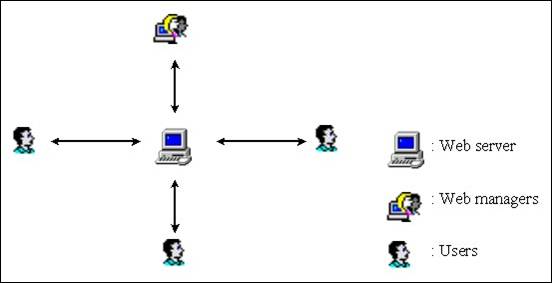
The website manager has a span class="en">one to multipleᦼspan class="en"> interaction with users through internet. The website manager will provide all web function, service content and all learning activities.
In practice, it is impossible to prepare complete and sophisticated learning material, achievement test, and all peripheral participation by a single manager or few individuals. It reflects the facts that a lot of existing learning websites that are lacking of updating or content depth.
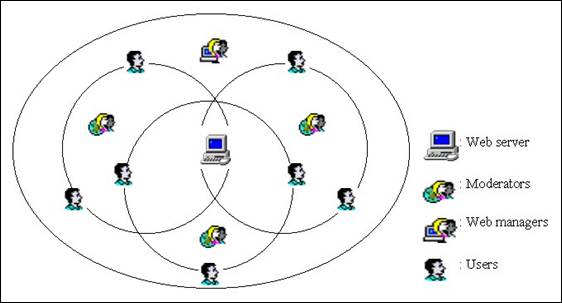
Therefore, the author brought a new span class="en">web community modelᦼspan class="en"> as Figure 2.
This model designed two different interactions: systems functions and information contents. The website manager would only take the former responsibility. The information contents would be divided into more sub communities or interest groups that would be coordinated by external moderators. It was expected that there would be some interlaced area between groups, thus it would be linked as an integrated community. Group moderators did not have to worry about the web techniques, they could be concentrated to develop the learning behavioral interaction for users.
Figure 2. Web Community Model
Culture
Internet makes the earth smaller, brings the world into a village. When we are celebrating the international boundary is falling down; do we regret that the pluralistic colors are also vanishing?
Though there are millions web sites, we have found the inevitable trend that the web characters grow similar faces, wear same uniforms, their interactions are more and more following consistent pattern. We cannot tell which web site is from a certain corner of which continent.
It worried him when the author called for a seminar of designing a new web with his college students. When we needed an innocent leading actress, there was only Snow White left in studentsᦼspan class="en"> mind; when we made up a worrier model, the Black Knight came out; when we set up exploring plots, they were thinking of Star Trek. They ignored or forgot there are plenty of symbols and scientific fictional stories in Chinese history and mysteries. The young generation is losing its heritage of cultural imagination. (Wu, 1997)
The author suggested that we should remind web designers to consider span class="en">cultural featureᦼspan class="en"> to be an essential factor for designing web. It would be not interesting, if there were no cultural differences in the cyber world. (Wu, 1998; Wu et al. 1999)
Cultivation
Mediaᦼspan class="en">s form (or environment) is as well as content may produce cultivation effect to children, according to Gerbner et al. (1979)ᦼspan class="en">s series work concerning Media Sociology perspective. This idea may come from a long tradition of span class="en">The Medium is the Messageᦼspan class="en"> (McLuhan, 1966). It argued that media itself would affect audienceᦼspan class="en">s recognition, attitudes, and even behavior.
There were rich studies and documents on span class="en">TV cultivation theoriesᦼspan class="en"> in 1970s and 1980s. (Anderson, 1980; Hughes, 1980) Scholars advocated that there are heavy effects influencing children by television. They also found television would build up a span class="en">media realityᦼspan class="en"> which is far different from the span class="en">real realityᦼspan class="en">. span class="en">TV children syndromeᦼspan class="en"> was discovered and considered a serious problem.
However, there was still a positive angle to this effect. We could conclude that although media might distort oneᦼspan class="en">s behavioral development, while it also might inspire oneᦼspan class="en">s mental potential especially in his/her childhood.
WWW is the most powerful media next to television. When we reviewed the lessons from television, the author wanted to suggest that developing web is not only defining a mechanism but also initiating an organism that might cause cultivation between community members.
The effect of cultivation could be operationalized and explored by usersᦼspan class="en"> behavioral changes after their experiencing the new mediaᦼspan class="en">s form and environment. Therefore, the web community also needs a two-way feedback system to collect, measure, and interpret data that real usersᦼspan class="en"> innovation behavior, if there is any.
Current Learning Webs
The author thoroughly investigated ten significant current learning webs in Taiwan to understand if they also noticed the above three concepts. The observation could be summarized as:
Table 1.
Web Community
Culture
Cultivation
Yes
2
0
1
No
8
10
9
Most of learning webs were in radiation model, one way teaching, and without any culture consideration. This fact explained the emerging need and encouraged the author to develop an integrated web learning community environment.
Methodology
As an application research, four methods were employed:
1. Literature reviews.
2. Depth interviewing with experts whose major is in children education.
3. Web systems analysis and design. Four requirements had been defined, they were:
-Total Web-Based CAI: including structural learning materials, systematic learning achievement tests, scores database, users demographic database, parameters base, and analysis tools.
-Interactive learning navigation: guiding users how to solve problems with internet resources instead of telling them the answers.
-Collaborative classroom: creating an online virtue space for the moderator and users to allocate assignments, talk over problems, display output, and share knowledge.
-Community management: verifying the applications for moderators, recognizing the rights of them, providing tools and interfaces for moderators to prepare learning materials, tests, and other collaborative activities.
4. Field study on focus group: two primary schools, one in Gi-Lung City and the other in Tau-Yuan County, had been selected as focus group, interaction and usersᦼspan class="en"> feed back had been analyzed for further rigid experiments.
Results
Community Environment and User Interface
The web was named span class="en">Gold Peach Web Communityᦼspan class="en">. Gold Peach is a magic fruit in West Holy Motherᦼspan class="en">s garden based on Chinese ancient legend. You could navigate the cloud and explore unknown world after eating the Peach. The sprit of scientific fiction is as keen as modern imagination.
Since Gold Peach also appears in the famous Chinese classic fiction span class="en">The story of the venture tour to Westᦼspan class="en">, we adopted and inherited the background, characters and plots from the story to create the cyber environment of the web as Figure 3.
Figure 3. Gold Peach Entrance

After logging in the community, the child users could play roles as Magic Monkey, Pig, Sandman, Dragon Horse or other genius etc. They could follow Master Monk to break in 81 forbidden area that were controlled by different monsters and demons. They could steal Gold Peach to surf the WWW to find out the answers for their questions. Or, they might join one of parties in Flower Island where they could chat or work out a task together.
Interactive Learning Design Process
The moderator (teacher or expert) users could apply to be god or goddess in South Heaven Palace. After verification procedure, they would be authorized to be in charge a specific interest group to develop the learning interaction with child users.
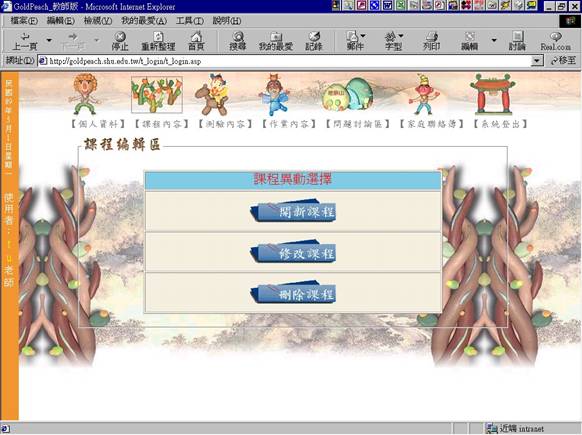
With a easy, step-wise, and flexible tool (see Figure 4), they could plan their syllabus and learning units. It was easy to reorganize and modify chapters and sections.
Figure 4. Design Process
There were multiple functions to support moderators to arrange test. They could use either closed-ended or open-ended questions, single option or multiple choices. They also wanted to design some hints for the users who did not pass the test. They could set links to the internet resources where buried the treasure of answers.
They could also direct a virtue seminar or assign a fieldwork. All participants could exchange their idea or experiences upon moderatorsᦼspan class="en"> requests.
All closed-ended questions in tests would be graded automatically while moderators would mark the open-ended questions.
The users scores and evaluations would be computed and organized in database. A parameter framework would be derived from a certain amount of accumulative data later on. In the same time, a report of userᦼspan class="en">s learning achievement would be prepared for useᦼspan class="en">s parents through web connection. Parents also could reply their comments to the moderators.
Conclusions and Discussions
Web Community: A progressive idea for learning environment
Web Community could be considered as a progressive idea for learning environment. It improved traditional one-way teaching and display and realized total peripheral participation and interaction.
The specification of span class="en">Gold Peach Web Communityᦼspan class="en"> could be summarized as the following:
Developing interactive learning platform and environment where all community members could learn, solve problems, and share knowledge.
Consolidating learning contents that were combined primary schoolsᦼspan class="en"> curricula with internet resources and information.
Reviewing and categorizing current information and webs that are suitable and interesting for children.
Culture: A deficiency, excess and integration trace
Three generations of the user interface were developed during last a few years. It revealed the introspection on seeking the cultural feature of web design.
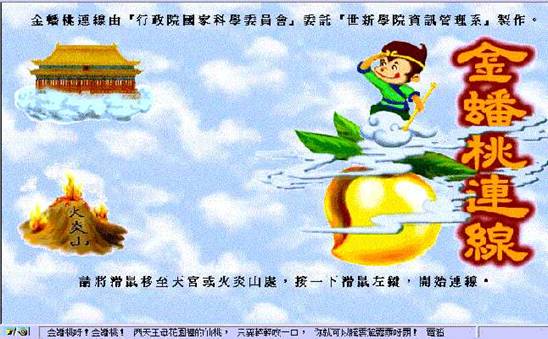
Though the span class="en">culture requirementᦼspan class="en"> was highlighted according to the web developing strategy for the 1st generation, the implement was relatively unsuccessful. The artists in the project team were still lost in the long term Westernized training. The leading role, Magic Monkey, was cute, but lack of originality. The presentation of icons and background were inevitably under European shadow. (See Figure 5)
Figure 5. 1st Generation
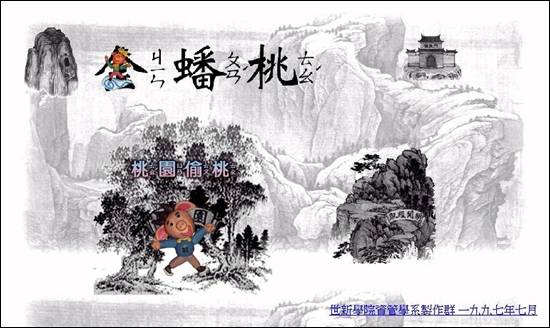
The effort on discovering lost tradition inspired the using of Chinese ink and calligraphy art to stylize the home page for the 2nd generation. The cultural specification was distinguished, however, the black-and-white idea was too abstract to attract childrenᦼspan class="en">s attention. (See Figure 6)
We did not find a balance between cultural skill and modern technique until the 3rd generation. We inherit the 3-D model of Chinese flour idol and the styling interest of folk drama to cerate cyber characters. The objects in the background were Chinese materials with modern simplified geometric outlines. The real culture should be a living idea that contented historic and current context. (See Figure 3)
Figure 6. 2nd Generation
Cultivation: A ferment attempt
The result of this research span class="en">Gold Peach Communityᦼspan class="en"> was expected to guide a new direction and a new method for children to develop their abilities of learning and problem solving under silent and positive cultivation.
The effort to discover the cultivation effect was still under ferment period. However, this research investigated and accomplished some feedback mechanisms in the systems. They could detect and reveal possible cultivation effects by comparing users learning behaviors and achievement. Since cultivation is more likely a time series effect than a sudden change, the author suggests a large scaled and longitudinal experiment on this issue in the future studies.
References
[1] Anderson, James A. (1980); The Theoretical Lineage of Critical Viewing Curricula; Journal of Communication; Vol.30, No.: 64-70
[2] Hiltz, S. R.; Teaching in a Virtual classroom; Proceedings of the 5th International Conference on CAI;Taipei: NSC; invited paper; 1995
[3] Kearsley, G.; A Guide to Online Education; http://gwis.circ.gwu.edu/~etl/online. html; 1997
[4] Lave, J. & E. Wenger; Situated Learning: Legitimate Peripheral Participation; London: Cambridge Univ. Press; 1991
[5] McLuhan, Marshall(1966); Understanding Media: The Extensions of Man; NY: McGraw-Hill; Ch.1
[6] Gerbner, George, Larry Gross, Michael Morgan and Nancy Signorielli(1979); Television Viewing and Fear of Victimization: Specification or Spuriousness; Annenberg, Penn.: The Annenberg School of Communications, Univ. of Penn.
[7] Hughes, Michael; (1980); The Fruits of Cultivation Analysis: A Reexamination of Some Effects of Television Watching; Public Opinion Quarterly; 46: 287-302
[8] Qiou, Guei-Fa; (1996); Situated Learning Concept and Computer Assisted Learning; Taipei: National Normal Univ. Press
[9] Wu, Tung-Xiung and Yui-Liang Chen; (1999) Cultural and Cultivation Features on Web Designing: A Case Study of Gold Peach Community; In Bullinger, Hans-Jorg and Jurgen Ziegler (eds.) Human-Computer Interaction: Communication, Cooperation, and Application Design; Mahwah, N.J.: Lawrence Erlbaum Associates; Vol. 2, p:66-70
[10] Wu, Tung-Xiung; (1998); Gold Peach Web Community: A Research and Production Project; Taipei: Project of NSC: NSC-87-2515-S-128-001-CH
[11] Wu, Tung-Xiung; (1997); A Research on ᥅ducational functionᦠand ultural Specificationsᦠof Internet Services; Shih Hsin Journal; No. 6:115-27
