

Election Prediction

 |
 |
Predictive Achievements and Evidence
from 1980 to Present
My quantitative research into elections commenced in 1980. In 1983, I
pioneered the first large-scale electoral opinion survey in Taiwan, an
endeavor that was honored with the Golden Tripod Award. This research has
continued for over 40 years. In the realm of "vote prediction," whether for
single-seat or multi-seat elections, margin of error has consistently been smaller than
that of those observed commercial polls. A
more significant undertaking has been the dedicated research into "electoral
behavior," with the aim of developing long-term predictive models.
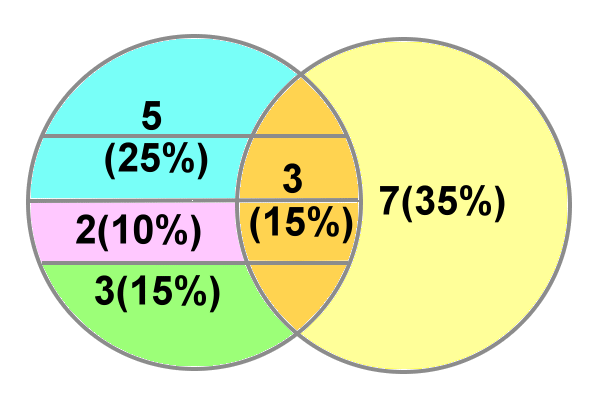
Since 1983, I developed an "Image Index" as a tool for vote prediction. This
led to the discovery of the "53237 Voter Structure" theory (originally the
"7535 Voter Structure"), which has been progressively published since 1986.
This theory holds the potential to evolve into a long-term cyclical
predictive model. In 1994, this model further indicated several significant
events that were likely to occur:
1.The Kuomintang (KMT) would
shrink.
2.A three-party competition would emerge. (This subsequently
occurred in 2000).
3.Chen Shui-bian would win the presidency by a
narrow margin. (This also occurred in 2000).
4.An analysis of
floating votes' oscillation suggested that the vote ratio between the KMT
and the Democratic Progressive Party (DPP) would shift from approximately
60:40, with one gaining while the other receded, and then vice versa,
eventually returning to 60:40 after one cycle. (Was this 2008?)
[Note: The preceding section was written in 2004 when this website was established, using a questioning tone. This was indeed confirmed in 2008.]
Electoral Predictions: Highlights
 2004
Presidential Election: When the general public anticipated a landslide
victory for Lien-Soong, I predicted that President Chen Shui-bian would win
by an extremely narrow margin, which would be accompanied by prolonged
disputes. Due to legal restrictions, I was unable to publicly disclose this
prediction in my personal capacity. However, I did share my forecast with
two scholars of international academic standing and significant academic
administrative positions, seeking their insights on potential solutions to
the impending societal discord. (This is documented in the "NCCU College of
Social Sciences Policy Forum").
2004
Presidential Election: When the general public anticipated a landslide
victory for Lien-Soong, I predicted that President Chen Shui-bian would win
by an extremely narrow margin, which would be accompanied by prolonged
disputes. Due to legal restrictions, I was unable to publicly disclose this
prediction in my personal capacity. However, I did share my forecast with
two scholars of international academic standing and significant academic
administrative positions, seeking their insights on potential solutions to
the impending societal discord. (This is documented in the "NCCU College of
Social Sciences Policy Forum").
2008 Presidential Election: On the
eve of the 2008 presidential election, I again presented my predictions to
two individuals, inviting them to serve as witnesses. I also noted that the
figures for the 2008 election might have been predicted by me more than two
decades prior, and this instance merely served as a validation.
My prediction for 2008 yielded an error
margin of 1.35%, which, among all presidential election forecasts I have
encountered, was the closest to the actual outcome.
2012 Presidential
Election: Prior to the 2012 presidential election, I shared my predictions
with several friends, inviting their collective observation. My prediction
for 2012 again achieved an error margin of 0.43%, once more proving to be
the closest to the actual results among all public opinion surveys.
2014 Taipei Mayoral Election: For the 2014 Taipei mayoral election, I
conducted a survey commissioned by a third party. Lacking a non-disclosure
agreement, I reported the election forecast to all three major political
factions (Blue, Green, White) eight weeks before the vote. The final error
margin was less than 1%, serving as further evidence of the relative
stability of human behavior.
2018 Kaohsiung Mayoral Election: On the
eve of the 2018 Kaohsiung mayoral election, I predicted the winners for each
administrative district to several friends, as well as groups of National
Taiwan University and Chien Kuo High School alumni. This achieved 100%
accuracy. More importantly, this might have been the first instance where
data and meta-analysis supported the theory that "circumstances create
heroes, not heroes create circumstances."
Methodological Distinction
The primary distinction between this research community's approach and
other electoral surveys lies in its pursuit of "pattern prediction" and
structural analysis through novel quantitative methods, as opposed to
conventional rapid-response polling. Regardless of whether it's a
single-seat or multi-seat election, the prediction error of this community
has never exceeded 2%.
For the 2024 Presidential Election, responding
to the needs of election practitioners and the challenge of fully
comprehending comprehensive behavioral predictions, I proposed the
"Meta-analysis Method." This approach integrates numerous public opinion
polls to achieve superior results. For further details, please refer to the
article "Comprehensive Review of Presidential Election Polls: Authoritative
Scholars Examine Each One!" from the "National Fact-Checking Society -
Understanding Polls," which introduces the meta-analysis method.
Adoption Modeling: A Fundamental Theory
Since 1996, I have also
conducted a long-term series of studies on the then-emerging behaviors of
internet and e-commerce usage. The findings reveal that these two seemingly
unrelated fields share a fundamental commonality: the "Adoption Modeling" of
human acquisition and selection behavior.
From a rigorous critical
perspective, current behavioral research has not yet fully met the
conditions to be considered a "science." One reason is the persistent lack
of fundamental "laws." It is hoped that Adoption Modeling can provide an
opportunity to explore these foundational laws.
The "53237
Voter Structure" and its underlying "Adoption Modeling" appear capable of
explaining and predicting long-term electoral behavior over approximately
30-year cycles.
TxNote: Good Theories are Stable
Over 40 years
of learning election prediction, I have fortunately never been wrong.
However, I constantly remind myself: human behavior is probabilistic
knowledge; be careful, this time could be the one I get wrong!
My two
main insights are:
1.If fundamental behavioral theories exist,
human behavior can be predicted.
TxNote: Good Methods are Dynamic
2.Society is constantly changing. After each prediction, I reflect on newly emerging problems and potential solutions. Current public opinion polling is a thousand times more challenging than when I pioneered election research in Taiwan in 1983. Therefore, each time, it is imperative to consider new issues arising from previous survey methods and to introduce novel, previously unresolved methods. Furthermore, one must not be limited to a single survey method but must integrate the "logic and techniques" of meta-analysis with various other quantitative methods.

Black Pool (Xuan Shui Yuan)
This site is also known as Xuan Shui Yuan,
derived from the "Knowledge Wanders North" chapter in the Outer Chapters of
Zhuangzi: "Knowledge wandered north above the Mysterious Water."
"Knowledge" (知, Zhi) is a fictitious name, nominally representing an
"omniscient one," yet whose actions are those of a "learner." Zhi journeyed
north to the "Black Pool" to visit Wu Wei Wei, Kuang Qu, and the
Yellow Emperor, seeking wisdom and resolution to doubts. Each responded
according to the implied meaning of their names. Based on this allusion,
Professor Tung-Hsiung Wu likens "Black Pool" to the Western Delphi,
symbolizing a place for seeking wisdom, resolving doubts, and predicting the
future.


