


and Information Systems
Shift in Orientation, Research Fields & Curriculum Design
 |
| 資管:運用資訊與網路科技達成知識的分享 |
Background: Evolution and Implications of Global IS Education
This article outlines the historical evolution of the "Information
Systems" (IS) discipline, primarily under the auspices of the Association
for Computing Machinery (ACM), and its collaborative efforts with IBM and
the Association for Information Systems (AIS). It examines their joint
research on the orientation of IS departments and curriculum design,
specifically focusing on the "Curricula Recommendations," including the
IS1982, IS2002, MSIS2006, IS2010, and IS2020 frameworks. Furthermore, it
analyzes the underlying causes of these evolutionary shifts, discusses their
implications for Information Management education in Taiwan, introduces the
English nomenclature of the IS discipline, and provides ongoing services for
IS education.
Founded in 1947, the ACM is a global professional
organization for computing practitioners, headquartered in the United
States, and is the world's first scientific and educational computing
society. Established in 1994, the AIS is the premier international academic
and professional organization dedicated to the field of Information Systems.
Issue: The Orientation of Information Systems and IS Education
How does Information Systems differ from other "Information-related" disciplines, such as Computer Engineering or Computer Science?
 Seeking Answers to the Differences Between IS and CS Through
a Song "Making a plane"
Seeking Answers to the Differences Between IS and CS Through
a Song "Making a plane"
The orientation of Information Systems can be summarized by addressing three
core dimensions:
1. **Academic (Learning)**: What are the
distinctions and integrations in educational objectives and curriculum
design between Information Systems, Computer Engineering, and Computer
Science?
2. **Practical (Application)**: What is the future job market
for IS graduates? What are their core competencies for employment?
3.
**Institutional (Characteristics)**: What are the unique developmental
characteristics of individual universities?
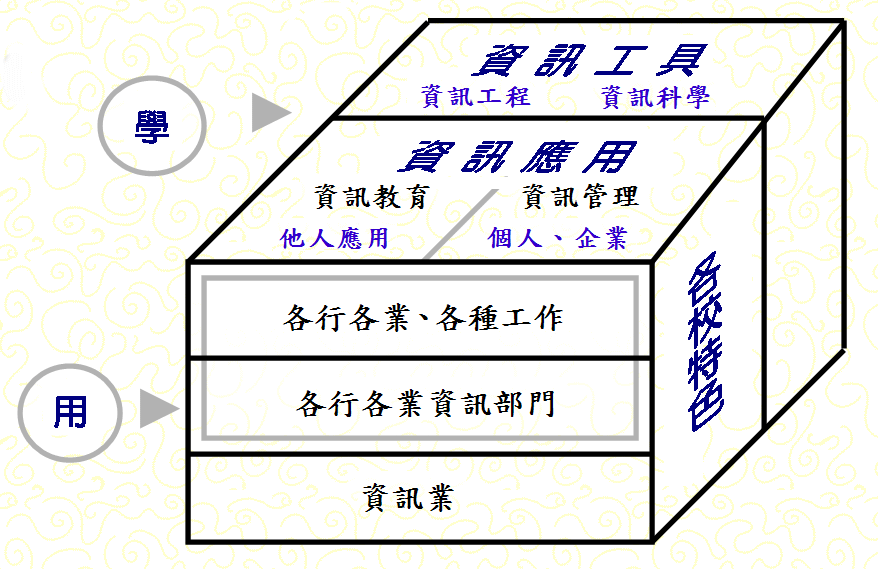
 The College Entrance Examination
Center's introduction and recommendations on "Information Management: Integration and Distinction"
The College Entrance Examination
Center's introduction and recommendations on "Information Management: Integration and Distinction"
The Evolution of Global IS Education and Taiwanese Characteristics
The first Management Information Systems (MIS) program was established in
1968 at the University of Minnesota, Twin Cities. As the application of
these systems expanded beyond mere "Management," the more comprehensive term
"Information Systems" (IS) became widely adopted. Initially, these programs
were often housed within Business Schools or as a track under the "Decision
Sciences" (DS) department. Over time, they gradually evolved into
independent departments, which is why older departments are frequently named
"Information Systems and Decision Sciences" (IS&DS). The IS discipline was
long affiliated with the DS society until the independent AIS was formed in
1994. Concurrently, IS mutually influenced Industrial Engineering (IE) and
Management Science, leading to the transformation of IE into Industrial and
Systems Engineering (ISyE). In recent years, numerous new programs have
emerged with highly diversified names (refer to the inset "English Names of
Information Management Departments" in this article).
When IS first
emerged as an independent research field, its pioneers primarily focused on
behavioral research, particularly the **"Adoption of Information Systems."**
To this day, papers in the premier US IS journal, *MIS Quarterly* (MISQ),
continue to revolve around this central theme. Over the past decade, the
journal's "Paper of the Year" awards have consistently been related to
behavioral research on adoption (involving keywords such as Adoption,
Implementation, Innovation, Cognitive-Affective). *(See:
http://www.misq.org/archivist/home.html)*
For the past 50 years,
Taiwan's educational policy has heavily emphasized cultivating talent in
science and engineering. Consequently, the majority of professionals
originate from Computer Engineering (CE) or Computer Science (CS)
backgrounds. In many Taiwanese universities, the Information Management
department functions essentially as a secondary CE or CS department.
Furthermore, the number of faculty members participating in international
CE/CS societies far exceeds those involved in international IS societies.
Under these circumstances, a curriculum design with distinct "Taiwanese
characteristics," quite different from international standards, has formed:
1. Information Management = CE/CS + The "Three Jies" (In Chinese, it
indicates: Economics,
Accounting, Statistics).
2. The proportion of CE/CS courses is
disproportionately high. The course content tends to lean towards the
back-end (algorithms) rather than the front-end (users). Even when
courses share the same name as their international counterparts, the content
design focuses on the bottom layer (tools) rather than the **top layer
(applications) of IS.
3. Within the Information Management discipline,
it is likely that many leaders who control national resources also endorse
these Taiwanese characteristics.
ACM/IBM IS Curricula and Shih Hsin University's IS Education
The author of this article served as the founding chair of the
Information Management Department at Shih Hsin University in 1992,
initiating research and design for the IS curriculum.
In 1981, the
AIS did not yet exist in the United States. IBM was the dominant force in
the IT industry, and the original concept of MIS was essentially a
commercial concept proposed by IBM (then called MoIS). IBM collaborated with
numerous universities, heavily promoting this curriculum design within
academia and industry. This design strongly reflected the early spirit of
IS, which aimed at behavioral research. There is extensive international
literature on IS curriculum design (refer to the selected bibliography on
this site).
After 1982, leadership in IS education shifted towards
the ACM. Subsequently, relevant literature almost exclusively originated
from ACM's research. Through surveys and expert seminars, the ACM formulated
undergraduate core curricula in 1982, 2002, and 2010, and established the
MSIS graduate curricula in 2002 and 2006.
In 1982, aiming for a
streamlined "core," the curriculum was set at 10 courses. However, achieving
such brevity proved difficult, resulting in an actual structure of 10+4
courses. By 2002, reflecting the increasing diversification of IS, the
framework expanded to 5 major knowledge areas + 10 courses + 1 prerequisite
course. In 2010, it was condensed again to 7 core courses, supplemented by 8
sample elective courses. The term "sample" was used to encourage
universities to develop unique elective courses beyond the suggested list.
The most prominent feature of the **ACM/AIS IS2020** curriculum design
is its emphasis on the **"Competency Model."** This signifies a stronger
focus on practical application, hands-on implementation, and effective
execution in curriculum design.
Outlines of the Common Syllabus in Information Systems


