




Strategy Must Be Empirically Verifiable!Globally Ranked #1 on GoogleDetailed Data and Analysis |
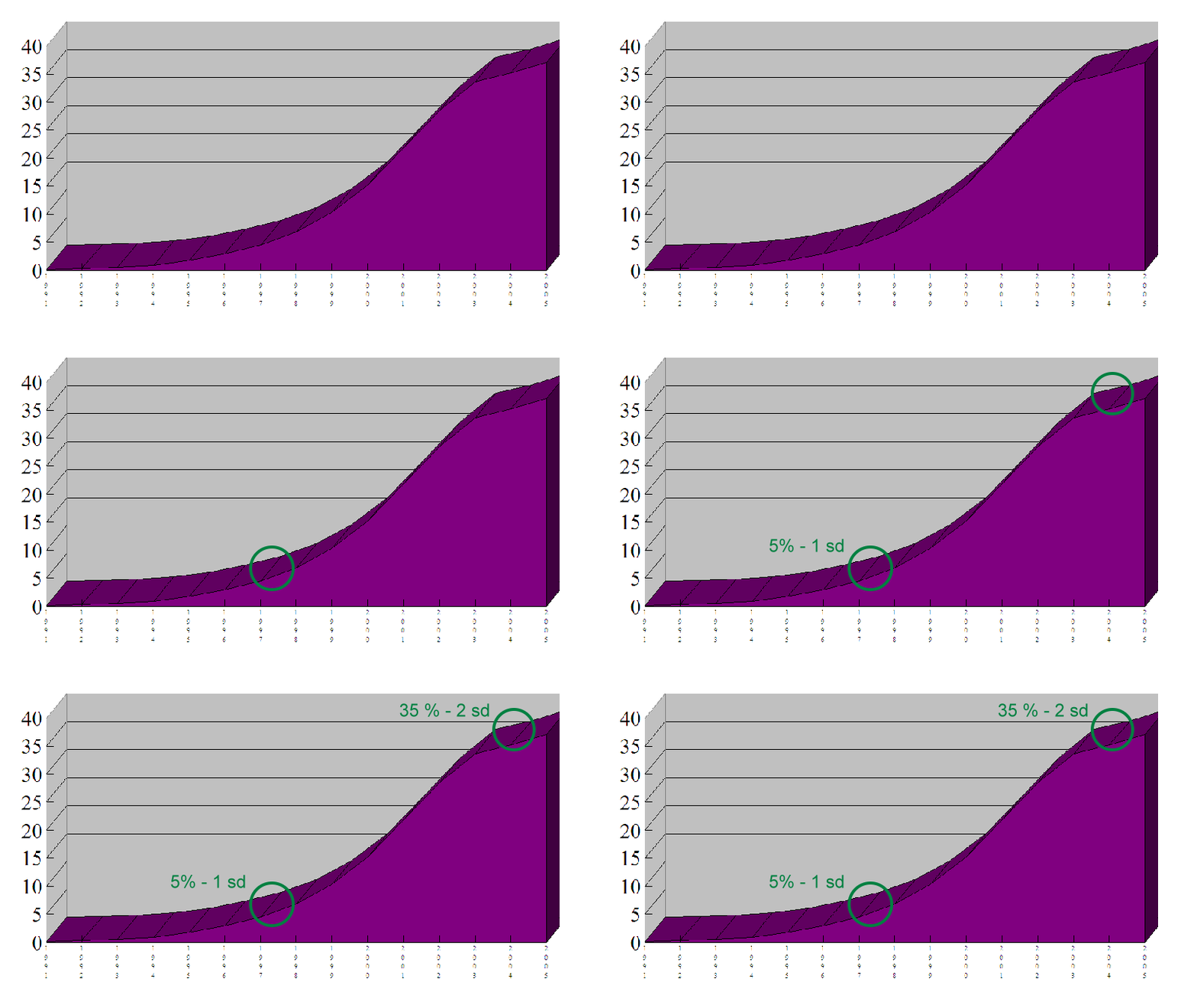
Our projections on e-commerce market growth and potential crises have been proven consistently accurate, standing the test of empirical facts. |
 E-commerce Domain
Types of e-Commerce (eC)
Strategies
Analytical Framework and Strategic Applications of Google
Analytics
About This Community
Founded in 1995
This community specializes in market research, user behavior, and strategic
management analysis within the fields of e-commerce and strategy. It
provides recommendations for both macro-level and micro-level strategic
applications, along with integrated services and exchanges related to
knowledge management.
It also presents chronicles of the predicted
bubble economy and the development trajectory of the e-commerce market.
To apply for strategic consulting, please click here
Websites receiving guidance from Professor Wu Tung-Hsiung have achieved 25%–100% growth within a short period.
Since the emergence of e-commerce after
1995, this research community has simultaneously conducted systematic
studies on both market and strategic dimensions. To date, it has carried out
approximately one large-scale random survey annually in Taiwan, verifying
the theories and predictions developed by the community.
It must be
acknowledged that marketing strategy often becomes subjective and
opinion-driven. Therefore, this research series emphasizes beginning with
fundamental theoretical construction, including modeling from consumer
demand behavior to develop the TX Adoption Model. This research series has
become one of the best empirical applications validating this model.
Early Forecast of the Dot-Com Bubble
E-commerce became an instant
phenomenon upon its emergence, attracting massive investments of talent and
social resources. However, Professor Wu Tung-Hsiung independently proposed
that research should focus on internet user behavior, developing a
predictive model of e-commerce market growth based on a tanh-like adoption
trend function, and publishing it within this research community.
In
December 1999, National Chiao Tung University hosted the International
Conference on Communication Technology. At the peak of the e-commerce boom,
the prevailing message was: “Act now or it will be too late!” All
participants urged governments, industry, and academia to invest resources
immediately.
When Professor Wu took the stage, he opened with:
“I
am the only one to step on the brake.”
His predictive model indicated
a significant gap between supply and demand in e-commerce, suggesting an
imminent crisis. This view drew skepticism, including criticism from an
American professor, while only one graduate student expressed support.
During the Spring Break of 2000, while delivering a lecture in New
Orleans, Professor Wu witnessed the outbreak of the Dot-Com Disaster and the
global bubble economy collapse, remarking:
“See? I told you three months
ago!”
Four Major Research Topics in E-commerce
Market Research:
Demographics and behavioral characteristics of internet users in Taiwan
Forecasting: Future trends, timing of changes, and implications
Strategic
Analysis: Consumer willingness, opportunities, and responses
Scientific
Quality: Development of new methodologies for online market research
Classification of the E-commerce Domain
E-commerce can be divided
into three categories:
Technical: Information security, transaction
certification, communication technologies, and efficiency
Operational:
Systems such as BA, ERP, e-commerce platforms, EDI, extending to SCM and CRM
Strategic:
Macro Strategy: Strategies within a region (e.g., Taiwan) or
global socio-economic environment
Micro Strategy: Strategies for
individual entities (organizations, enterprises, or individuals)
From
a tool-oriented perspective:
Technical = development of tools
Operational = application of tools to implement systems
Strategic = why
and how to use tools to achieve objectives
Types of E-commerce Strategic Indicators
Macro Indicators
Percentage of general internet users
Percentage of qualified internet users
Internet growth forecasting
indicators
User characteristics
Behavioral characteristics
Online
consumer characteristics
Pricing strategy ranges
Product strategy
items
Market barriers
Digital divide indicators
Micro Indicators
Google search rankings
Keyword ranking and traffic
Page views
Browsing duration
Pages per visitor
Bounce rate
Time on site
Strategic Framework
Marketing strategies can be categorized into:
Macro Strategies: Regional or global-level strategies
Micro
Strategies: Entity-level strategies within accessible environments
Macro strategies typically include user behavior, public/private sector
policies, market forecasts, pricing, product planning, market barriers,
digital divide, website presentation, and consumer behavior.
Challenges in E-commerce Market Research
Empirical and quantitative
research in e-commerce strategy is becoming increasingly difficult due to
two major challenges:
Methodological Challenges
Social changes
(technology, privacy awareness, fraud issues)
Increased difficulty in
sampling and data collection
Complexity in balancing retention (known
customers) vs. acquisition (unknown customers)
Resource Constraints
Rapid increase in costs (labor, materials, funding) between 2000–2005
As a result, the threshold for macro-strategy research continues to
rise.
Evolution of Analytical Tools
Before 2005, micro-level
strategy research was also highly challenging. Although traffic-based
analysis existed in the 1990s, limitations remained in:
Data coverage
Data access
Statistical methods
User interface design
In late 2005, Google acquired Urchin and launched Google Analytics, which, by 2009, had evolved into a powerful tool for strategic analysis due to its high data coverage and improved functionality. This evolution continued with the introduction of Universal Analytics in 2012, standardizing cross-platform tracking. Most recently, the platform underwent a fundamental paradigm shift with the launch of Google Analytics 4 (GA4) in 2020. Unlike its predecessors, GA4 prioritizes privacy-centric tracking and event-based modeling, replacing session-based data to provide deeper, AI-driven insights into the modern user journey.
Google Analytics is particularly
suitable for micro-strategy analysis, which is often more directly relevant
to organizations and enterprises.
While various traffic analysis
tools exist, this discussion adopts a tool-independent perspective, allowing
concepts to be applied across platforms.
The“Silver Jay”Community
The Silver Jay symbolizes a Jay bridge across the vast
Silver galaxy in traditional Chinese science fiction. In the modern digital era, it
represents a bridge across the boundless internet, guiding optimal
navigation strategies.
This community serves as an interactive
learning platform for:
Doctoral courses: Internet and Communication
Studies
Master’s courses: E-commerce and E-commerce Marketing Strategy
Other interested participants
It facilitates cross-class, cross-year
interaction, knowledge exchange, collaborative learning, and the
presentation of academic findings.
The community specializes in:
Internet usage development
Market forecasting
Consumer behavior
Product and pricing strategies
Decision support for public and private
sectors
Due to the global nature of the internet, English (especially
American English) is essential. Therefore, this platform also supports
discussion and application of business English.
Participation and Interaction
This community showcases students’ learning outcomes and
processes. Participants are encouraged to engage voluntarily in the
discussion forum for mutual support and growth.
Visitors are also
welcome to observe, provide feedback, and apply for membership to gain
interactive access.


