

曲式分析與設計
 English
如將音樂作品視為人類心靈創作的藝術觀,各音樂要素如果擬人化,旋律就是骨架、和聲是血肉、節奏是行為,音色配器是服飾與佩件,而曲式則為此人角色與活動環境的全設計。
對成熟的創作者,應是先有一個完整的曲式藍圖,再由:旋律、和聲、節奏、音色配器的程序,循序創作。
不過,對初學者,可能先由:旋律、和聲、節奏、音色配器的程序創作,最後再處理曲式。
什麼是曲式?
「曲式」就是「統雄美學論」中「構成論」所討論的「結構」。而完整的結構,經常就是「起承轉合」。
音樂結構的單位是「樂句」與「樂段」。
西方樂理對曲式的分類雖然很多,常見的單位分析如下例:
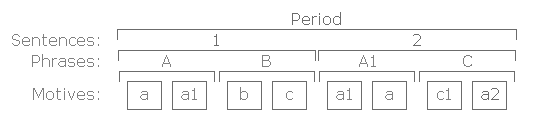
西方的用詞如果直譯,和中文不盡切合,故將其意譯、並與中華美學觀念整合解釋如下:
Motive:樂句
Phrase/ Part:小樂段
Sentence:大樂段
Period/ Movement:樂章
整合中西方音樂美學,完整樂章結構意義就是:起(a)承(a1)轉(B)合(Sentence 2)
樂句一般常直譯為「動機」,即「起」,其後經常跟隨「模進(imitation)」的樂句,即「承」。
在實務上,我們會發現「小樂段」和「大樂段」的界限是模糊的,可簡化為樂段。而在體制較小的音樂結構-如歌曲中,經常由樂句擔任起承轉合的結構。
單樂章曲式的結構分類 Forms by Structure
統雄老師整合中西方音樂美學,將單樂章的結構歸納為3大類型:
The term 'musical form' is used in two related ways: (1) a generic type of composition such as the symphony or concerto; (2) the structure of a particular piece, how its parts are put together to make the whole; this too can be generic, such as binary form or sonata form. Musical form (the whole or structure) is contrasted with content (the parts) or with surface (the detail), but there is no clear line between the two. In most cases, the form of a piece should produce a balance between statement and restatement, unity and variety, contrast and connection. There is some overlap between musical form and musical genre. The latter term is more likely to be used when referring to particular styles of music (such as classical music or rock music) as determined by things such as harmonic language, typical rhythms, types of musical instrument used and geographical origin. The phrase 'musical form' is typically used when talking about a particular type or structure within those genres. For example, the twelve bar blues is a specific form often found in the genres of blues and rock and roll music.
 Sean
TX's comments 對西方古典曲式的評論、詮釋與再發展
Sean
TX's comments 對西方古典曲式的評論、詮釋與再發展
All musical forms could be categorized into the following three types:
簡單型 Simple type
所有一句、二句的曲式,適合:民歌、童謠、團康、軍歌、廣告、和為了動員目的的群眾樂曲。
不過,也有可能是不成熟的結構。
在西方樂理中,簡單型又可分為:1 句型 A-form、2 句型 Binary form。注意:有些文獻,把這裡的「句」視為「段」。
It consists 1 or 2-part form and good for folk songs, nursery rhymes, marching songs, commercials, campaign music ... etc.
However, it also could be recognized as a premature form.
1 句曲式 A-form
1 段曲式 A-form 是只有「起」句。
This simplest form is used to be for casual, folk, and kid's music. It could be very popular to spread out since its easy performance. However, its depth will be constrained.
2 句曲式 Binary form
2 段曲式 Binary form 是具備「起轉」或「起承」。
Most strictly, a piece in binary form will be in two halves (AB or AA'), equal in length. The first half will start in a certain key (or on a certain tonic), and end in a different key. The second half of the piece begins in the key that the first half ended in, and ends in the original key of the piece. The second half may also be repeated. If the key at the start was a major one, the key at the end of the first part will generally be the dominant of it (a fifth above), so that a piece beginning in C major will end the first half in G major. If the starting key is minor, the music will generally move to its relative major key, so if a piece starts in C minor, it will end the first half in E flat major. The first half is often repeated. The gavotte, for example, is typically in binary form.
反復型式(曲式)Strophic form
Strophic form 也稱為 verse-repeating form, chorus form, AAA song form, 或 one-part song form。中文譯為「分節歌」。
其實就是 1 句曲式 A-form 或 2 句曲式 Binary form,而有許多段歌詞,同旋律反復。其強調的是歌詞結構,不是旋律結構,所以名稱上雖然有 form,但我不建議視為曲式的一個分類。
完整型/ 多句曲式 Complete type/Ternary form
包括二段以上,三句、主要是四句的曲式。統雄命名其為「完整型」,是因為它反映了「統雄美學論」中「統一與變化論」的完整組織,也符合中華古典表現理論的「起承轉合」、或西方的「(起承)轉合」結構。
如何使用音樂元件實現樂曲的「起承轉合」?
在「承」的技術上,最常用的就是旋律「模進」,包括平行模進、逆向模進,還有較高級的對位模進等。
而在「轉」的技術上,常用和弦轉調與「節奏型」變化,最佳效果就是合併應用,同時再以有對比性的配器法表現。
也因為有「轉」,所以也最少有 2 樂段。
進一步介述請參考「和弦進行設計」、「節奏分析與設計」與「配器分析與設計」。
西方稱此結構為多句型 Ternary form,直譯是 3 句型,即包括了「起(含承)轉合」3 個功能的樂句。
It has three parts. In Western classical music a simple ternary form has a third section that is a recapitulation of the first (ABA). Often the first section is repeated (AABA) This approach was popular in the 18th-century operatic aria and was called da capo (i.e. "repeat from the top") form: later it gave rise to the 32-bar song, the B section then often being called the "middle eight". A song has more need than a dance of a self-contained form with a beginning and an end.
Sean
TX comment: Its literal meaning is 3-part form, however, its practice is
4-part form.
There are ternary form, song form, verse-chorus form and sonata form that are 3-part or 4-part forms in this type.
I use "Complete" to indicate that this type matches the complete structure of "Aesthetic Fundamental" that requires "Coherence and Variants".
Though these ideas of musical forms come from Western culture, they coincide with the Chinese classic aesthetic theory of "4-part composition" that are motivation (introduction), imitation (repeating, supporting), modulation (transition) and cadence (summing up). The complete structure is as follow.
Leading to motivation
Developing the imitation
Changing to modulation
Resolving to cadence
發展型 Extended type
超過二段、四句的設計,以表現更精緻的藝術技巧或更豐富的內涵。
不過,無論多少段,應該還是建築在「起承轉合」的基礎上,作變化式發揮。最有名的例子,如Beethoven的 Fur Elise。
如果只是段落多,結構零亂,有可能只是反映藝術功力不足。
成功的例子:
The Show
Any form has more than 4-part design such as rondo form.
The purpose of this type is to deliver intensive artistic expression or more sophisticated contents.
According to Sean TX definition, this type should still be based on the 4-part ground and has a reasonable progressive growing structure. Otherwise, too many parts could be a disorderly collection of broken pieces.
單樂章曲式的風格分類 Forms by Styles/ Performances
Simple Song form 簡單歌曲曲式
Song form 歌曲曲式即 1 段、3句以上的曲式。
A term used to describe a simple ABA or ternary structure as employed in many slow movements, although it is best avoided as many songs do not have this structure. In popular music, most song forms are in the binary or ternary forms AABB and ABA respectively or, the standard jazz formula, AABA, musical form common in popular music and predominant in rock since the 1960s.
Verse-chorus form 主副歌曲曲式
Verse-chorus form 主副歌曲式,可視為雙樂章曲式,不過,副歌不一定具備完整的樂章結構。
以上歌曲的「轉」,通常不是旋律轉調,而是編曲者為了豐富血肉的和弦轉調。
In contrast to AABA form, which is focused on the verse (contrasted and prepared by the bridge), in verse-chorus form the chorus is highlighted contrasting melodically, rhythmically and harmonically with greater dynamics and added instrumentation.
Sonata form (aka. sonata allegro form) 奏鳴曲式/快板
奏鳴曲式的標準結構如下:
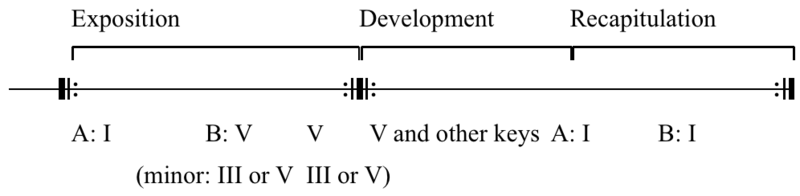
統雄老師指出:奏鳴曲式雖然使用「展示-發展-再現」的結構命名,其實還是「(起承)轉合」的結構,尤其強調「轉」必須旋律轉調。
Sean
TX comment: Mostly, the Aab is the same as AA', thus, it still is an
AABA 4-part form with a coda.
Originally, it emphasizes the form of instrumental music that is a comparison to vocal music form (cantata). Now, it becomes a general idea that may be subdivided into two or three themes or theme groups which are taken asunder and recombined to form the "B" part (the Development) - thus e. g. (AabB[dev. of a and/or b]A1ab1+coda). This developmental form is generally confined to certain sections of the piece, as to the middle section of the first movement of a sonata, though nineteenth-century composers such as Berlioz, Liszt and Wagner made valiant efforts to derive large-scale works purely or mainly from the motif.
Rondo form 迴旋曲式
Rondo form 迴旋曲式,可視為多樂句的發展曲式,即其「轉句」使用多個不同變化。
rondo, and its French equivalent rondeau, is a word that has been used in music in a number of ways, most often in reference to a musical form, but also in reference to a character-type that is distinct from the form. In rondo form, a principal theme (sometimes called the 'refrain') alternates with one or more contrasting themes, variously called 'digressions', 'couplets', 'episodes', or 'subordinate themes'. The overall form can be represented as ABACADA.... The number of themes can vary from piece to piece, and the recurring element is sometimes embellished or shortened in order to provide for variation.
Other forms 其他曲式
其他曲式多是細微建構物件的調整或發展,不必太受名詞所惑、或被拘束。
You may find a lot of other different forms from many literature.
However, there are all variants or derivatives from the above fundamental forms.


